Hyaluronic acid is everywhere. It is in serums, moisturizers, cleansers, eye creams, sheet masks, and an increasing number of products that have no particular reason to feature it as a headline ingredient. It has become so ubiquitous that "contains hyaluronic acid" functions as a general signal for "moisturizing" — and like most skincare shorthand, that conflation causes real confusion about how to use it correctly.
Hyaluronic acid is genuinely useful. It is also genuinely misunderstood. This piece covers what it actually does, why molecular weight matters more than most labels acknowledge, what the humectant trap is and how to avoid it, and what to look for when evaluating an HA product.
What hyaluronic acid actually is
Hyaluronic acid (HA) is a glycosaminoglycan — a long-chain polysaccharide that occurs naturally in the skin, connective tissue, and eyes. In the skin, it lives primarily in the dermis, where it functions as part of the extracellular matrix and can hold up to 1,000 times its weight in water.
Its job, in the simplest terms, is water retention. Not active hydration — retention. It acts as a reservoir, drawing water molecules toward it and holding them in place. When the skin's natural HA content is robust, skin looks plump and resilient, and recovers faster from environmental stress. When it is depleted — through UV exposure, chronic inflammation, or normal biological change over time — skin has a harder time maintaining its moisture balance.
In skincare products, HA is used as a topical humectant. Applied to the skin, it draws water toward the surface — from the environment, the product itself, or deeper skin layers — and holds it there.
Why molecular weight matters
Here is where it becomes more nuanced, and where most product marketing is least honest.
Hyaluronic acid is not one thing. It comes in multiple molecular weights, and these behave differently on and in the skin:
- ◦High molecular weight HA (above approximately 1000 kDa) sits on the skin surface. The molecules are too large to penetrate. What they do is form a water-binding film that reduces transepidermal water loss and provides an immediate, visible plumping effect. Effective for surface comfort and immediate hydration feel — but working at the skin surface, not within it.
- ◦Low molecular weight HA (below approximately 50 kDa) can penetrate into the upper layers of the skin. It reaches deeper, supports hydration more sustainably, and is better suited for skin that needs moisture support beneath the surface. In very small molecular fragments, it may also have mild anti-inflammatory properties.
- ◦Medium molecular weight HA bridges both — some surface work, some penetration.
A product containing only high molecular weight HA is doing one job. A product containing multiple molecular weights is working at several depths simultaneously — a meaningfully different proposition.
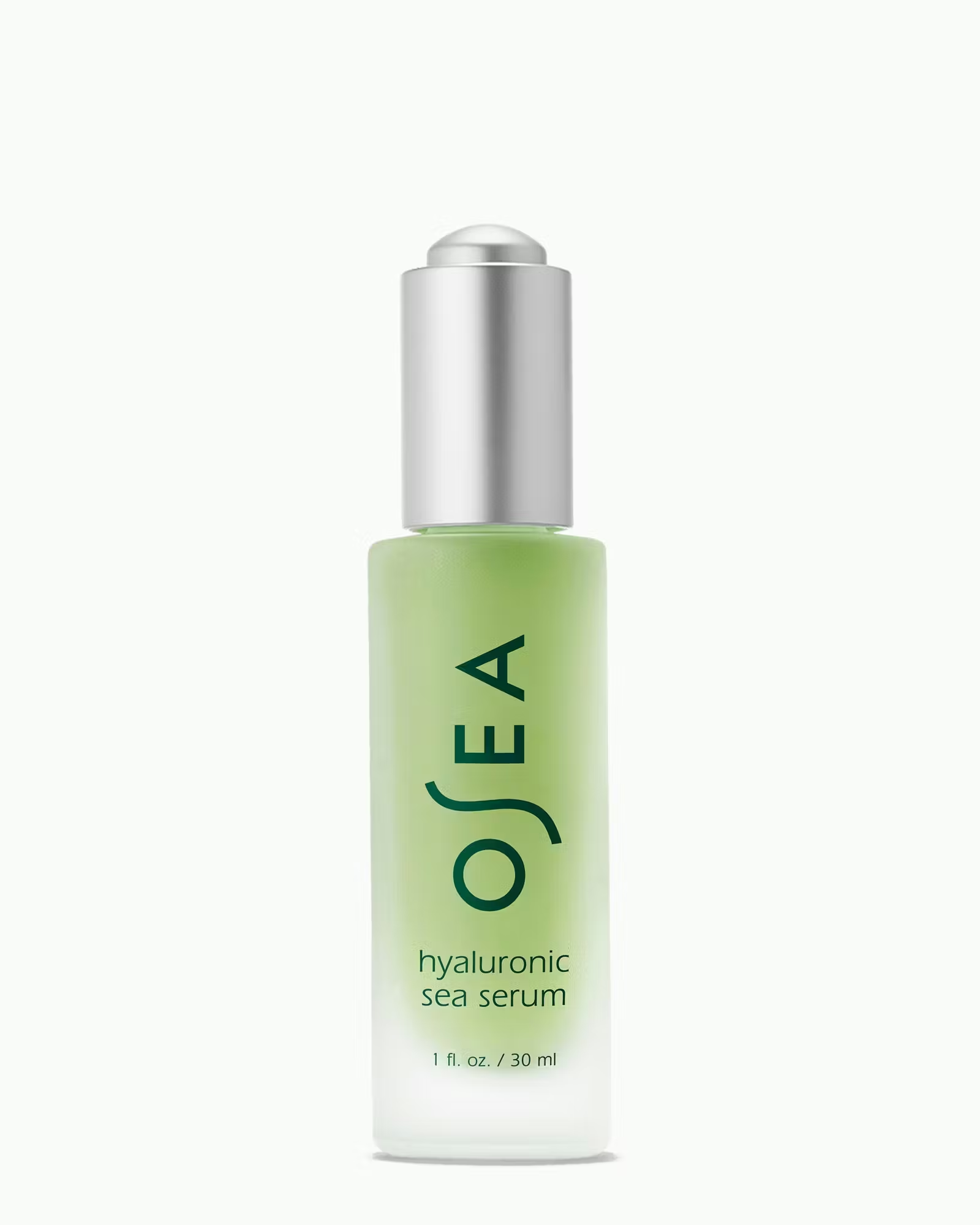
The OSEA Hyaluronic Sea Serum is one of the products we score highest for this reason. It uses three weights of HA alongside OSEA's seaweed complex — covering the surface, the near-surface, and deeper into the skin simultaneously. That layered approach is reflected in its 8.8/10 overall score, with a 9.5 for both feel and skin compatibility.
Most products don't specify molecular weight on the label. You can sometimes infer it from ingredient nomenclature:
- ◦Sodium Hyaluronate = typically lower molecular weight, better penetration
- ◦Hyaluronic Acid = typically higher molecular weight, surface effect
- ◦Hydrolyzed Hyaluronic Acid = very low molecular weight, deepest penetration
- ◦Sodium Acetylated Hyaluronate = modified form with improved skin adhesion and sustained release
If a product lists only Sodium Hyaluronate in the middle of a long ingredient list, it is providing some hydration effect — but probably not at the concentration the marketing implies.
The humectant trap
Hyaluronic acid is a humectant — it draws water from whatever water source is available nearby. This is the source of one of the most common and least-discussed mistakes people make with HA serums.
In a humid environment, humectants draw moisture from the air. This is the ideal condition — they pull atmospheric moisture to the skin surface and hold it there. But in a dry environment — indoor heating in winter, low-humidity climates, air-conditioned spaces — there is not enough atmospheric moisture to draw from. In these conditions, HA will draw water from the deeper layers of the skin toward the surface, where it then evaporates. You apply your serum and your skin becomes drier over the course of the day, not more hydrated.
The fix is not to stop using hyaluronic acid. The fix is two-part: apply it to damp skin (immediately after cleansing, before the skin has fully dried) to give it an immediate moisture source, and always follow with an occlusive layer — a moisturizer, face oil, or balm — that seals the surface and prevents evaporation. The humectant draws water in. The occlusive keeps it there. That sequence is not optional in dry environments. It is the whole mechanism.
Humectant on damp skin, occlusive on top, in that order, every time. This applies equally to glycerin, panthenol, aloe vera, and every other humectant in your routine.
Why more isn't always better
Products sometimes compete on HA concentration — "5% hyaluronic acid complex" as a headline claim. This number is largely meaningless as a standalone metric.
Beyond a certain threshold, more humectant in a formula does not deliver more hydration. It delivers more surface tackiness, more likelihood of pilling under makeup, and in low-humidity conditions, a greater potential for the backfilling effect described above. A well-formulated 0.5% multi-weight HA serum applied to damp skin before an occlusive will outperform a 5% single-weight formula applied to dry skin with nothing on top — every time.
Formulation context matters more than percentage. How the HA is buffered. What it is paired with. Whether the formula includes complementary humectants or penetration enhancers. These variables determine whether a product delivers meaningful hydration or simply occupies a step in your routine.
What to look for
When evaluating an HA product:
- ◦Check for multiple HA nomenclatures in the ingredient list — coverage at multiple depths
- ◦Look at where HA appears in the list — within the first five to eight ingredients for meaningful concentration
- ◦Confirm you have an occlusive to layer on top
- ◦Consider your climate — damp skin application is especially important in dry conditions
Hyaluronic acid at its best is one of the most reliable and universally compatible ingredients in skincare. Understood well, it earns its place in almost any routine. Misunderstood, it is an expensive way to feel like you are doing something.
See our full scoring methodology for how we assess ingredient quality and formulation integrity across all product categories.