"Retinoid" and "retinol" are used interchangeably in most skincare content, which creates a persistent confusion that makes it harder to choose the right product and set realistic expectations for any of them. Here is what the terms actually mean and how the full family of vitamin A derivatives compares.
The retinoid family
All retinoids are derivatives of vitamin A. What distinguishes them is how many conversion steps stand between them and retinoic acid — the biologically active form that binds to retinoic acid receptors in the skin and produces the effects retinoids are known for.
- ◦Retinoic acid (tretinoin) is the active form. No conversion required. Binds directly to receptors. Fastest results, most extensive clinical evidence, highest irritation potential. Prescription-only in the United States and most markets. If you are seeing a dermatologist and want maximum efficacy with guidance, this is what you ask about.
- ◦Retinal (retinaldehyde) converts once to retinoic acid. Meaningfully effective — some research suggests results approaching tretinoin at equivalent concentrations, though with more irritation than retinol. Growing availability in OTC formulations. A reasonable middle option for skin that has already tolerated retinol for at least six months.
- ◦Retinol converts twice: retinol becomes retinal, retinal becomes retinoic acid. The most widely available and most used OTC retinoid. Effective at appropriate concentrations (0.1–1.0%) with a more manageable irritation profile than retinal or retinoic acid. This is what the majority of retinol products contain.
- ◦Retinyl esters (retinyl palmitate, retinyl acetate, retinyl propionate) convert three times before reaching active form. Gentlest and slowest. The right starting point for very sensitive skin, rosacea-prone skin, or anyone who has previously reacted to retinol. Expect a longer timeline for visible effects.
Bakuchiol: the non-retinoid alternative
Bakuchiol is plant-derived from Psoralea corylifolia seeds and is often marketed as a "natural retinol alternative." It is not a retinoid — it acts through a different mechanism — but some research suggests overlapping endpoints including texture support, brightness, and barrier maintenance without the irritation pathway that retinoids trigger.
It is genuinely useful for: pregnancy (when retinoids are contraindicated), very reactive or sensitized skin, and anyone who has repeatedly failed to tolerate retinol despite careful introduction. It is not a like-for-like replacement for retinol in terms of the depth or pace of structural support. Think of it as occupying an adjacent lane.
Why concentration is only part of the story
Retinol percentages on labels are a starting point, not a full picture. Formulation matters at least as much. Encapsulated retinol — where the active is enclosed in a delivery system that releases it gradually after penetration — produces more consistent results with lower irritation than an unencapsulated retinol at the same percentage. Airless packaging stabilizes retinol against oxidation; a jar with repeated air exposure can degrade the active before it reaches the skin. The supporting cast — barrier ingredients, pH, the presence or absence of sensitizing fragrance — determines how much of the retinol's activity the skin can actually use.
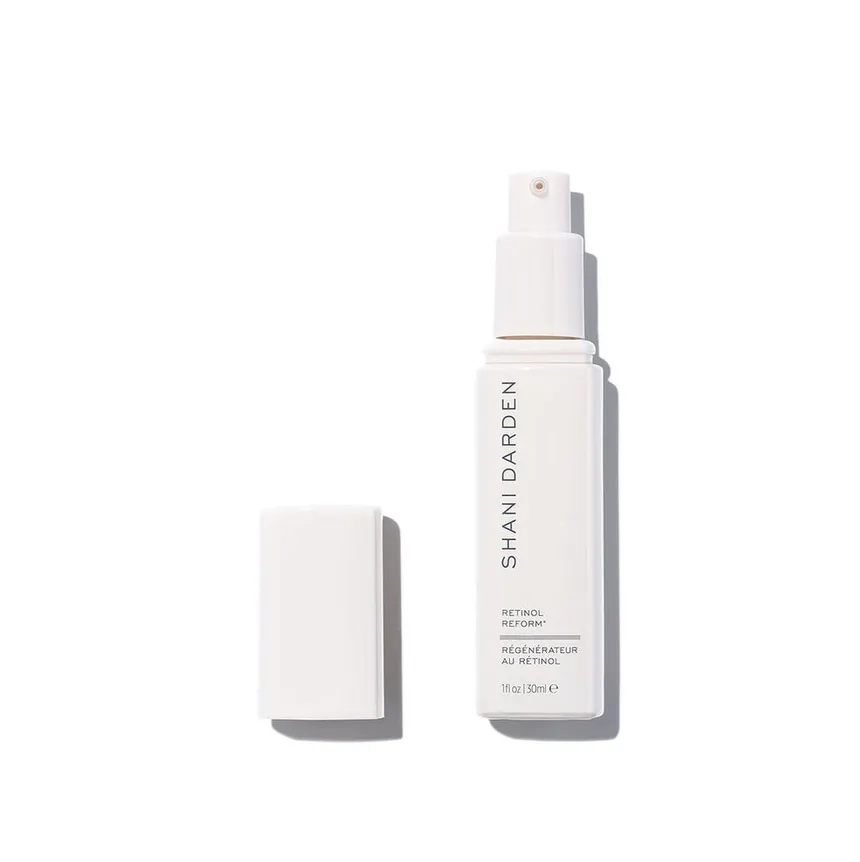
The Shani Darden Retinol Reform uses encapsulated retinol at 2.5% alongside lactic acid — formulated for effective delivery with controlled irritation. It is the highest-scoring retinol in our database at 8.9/10, with a 9.0 for results and 8.5 for skin compatibility. The encapsulation and airless pump are two of the main reasons it scores where it does.
How to introduce any retinoid without destroying your barrier
The most common retinoid mistake is not using the wrong product — it is using a reasonable product too often before the skin has adapted.
The protocol that minimizes disruption:
- ◦Start once weekly. Regardless of what the packaging suggests. One night per week for the first two weeks.
- ◦Apply to dry skin. Allow skin to fully dry after cleansing before applying retinol. Damp skin absorbs actives faster, which increases irritation without proportionally increasing benefit.
- ◦Nothing else active that night. No AHAs, BHAs, vitamin C, or other retinoids on retinol nights. These combinations amplify irritation significantly.
- ◦Barrier support immediately after. A ceramide-rich moisturizer or nourishing face oil applied on top seals the retinol in and reduces the chance of barrier disruption overnight.
- ◦Build gradually. After two weeks at once weekly with no reaction, move to twice weekly. After another month, three times. Most skin reaches a stable twice-to-three-times-weekly cadence and stays there.
If skin becomes red, flaky, or stinging: do not push through. Drop back to once weekly. The "retinoid purge" is real but often overstated — genuine barrier disruption is not a phase to power through, it is a signal to slow down.
Which type is right for your skin?
If you are starting out with normal or combination skin: retinol at 0.1–0.25% used once weekly is the right entry point. Give it three months before evaluating.
If you have sensitive or very reactive skin: retinyl ester-based products or bakuchiol first. Build tolerance over six months before attempting retinol proper.
If you have used retinol consistently for a year or more with good tolerance: retinal or an encapsulated high-percentage retinol like Retinol Reform may offer meaningfully faster results without a full prescription.
If you are working with a dermatologist: ask about prescription tretinoin. It has the deepest clinical evidence base of anything in this family and is often more cost-effective than premium OTC retinoids.
See how we score ingredient formulation integrity on the methodology page.